 Add to Chrome
 Add to Firefox
 Add to Edge
L2IR: Revealing Latent Intent in Graph Fraud Detection
May 25, 2026
Graph fraud detection has long depended on Graph Neural Networks (GNNs) to propagate and aggregate information across relational data. A critical obstacle in practice, however, is that fraudsters frequently disguise themselves by forging numerous connections with benign users, causing fraud signals to be progressively diluted during neighborhood aggregation and undermining detection reliability. While recent efforts have used Large Language Models (LLMs) to provide rich semantic cues for fraud detection, the underlying intent behind suspicious connections remains insufficiently explored. Compounding this issue, the scarcity of annotated fraud samples makes it difficult to train detectors that remain robust under heavy camouflage. To address these gaps, we propose L2IR, an LLM-driven Latent Intent Revealing framework for graph fraud detection. By uncovering latent intent from both user behaviors and suspicious connections, L2IR extracts intent-aware representations from raw behavioral traces and reasons about the true purpose behind individual connections, effectively distinguishing supportive links from misleading ones. It further incorporates adaptive self-training to enhance robustness under limited supervision. Evaluations on two real-world datasets characterized by pervasive camouflage demonstrate that L2IR surpasses strong baselines and can function as a plug-in enhancement for a range of GNN-based detectors, improving AUPRC by up to 8.27%.

STaT: Resolving Shape Distortion in Non-Stationary Time Series via Tri-Modal Synergy
May 25, 2026Recent research in time series forecasting frequently investigates the integration of textual and visual modalities with numerical models to better navigate non-stationary environments. Despite delivering solid numerical results, existing multi-modal approaches usually encounter a dilemma: prioritizing the minimization of average errors can result in excessively smooth forecasts that overlook essential fluctuations. To resolve this limitation, we introduce STaT, an innovative multimodal architecture for Symbolic-Temporal-Textual Alignment, which seamlessly unites three synergistic modalities. Specifically, the symbolic modality converts continuous time series into discrete tokens, facilitating the accurate identification of structural patterns and turning points; the temporal modality extracts inherent sequential dependencies; and the textual modality leverages domain semantics to steer the macroscopic forecasting trends. Comprehensive evaluations on eight real-world benchmarks indicate that STaT delivers exceptional performance, enhancing conventional magnitude indicators by up to 8.9% while simultaneously decreasing shape distortion by up to 8.5%.
BPC-Net: Annotation-Free Skin Lesion Segmentation via Boundary Probability Calibration
Apr 07, 2026Annotation-free skin lesion segmentation is attractive for low-resource dermoscopic deployment. However, its performance remains constrained by three coupled challenges: noisy pseudo-label supervision, unstable transfer under limited target-domain data, and boundary probability under-confidence. Most existing annotation-free methods primarily focus on pseudo-label denoising. In contrast, the effect of compressed boundary probabilities on final mask quality has received less explicit attention, although it directly affects contour completeness and cannot be adequately corrected by global threshold adjustment alone. To address this issue, we propose BPC-Net, a boundary probability calibration framework for annotation-free skin lesion segmentation. The core of the framework is Gaussian Probability Smoothing (GPS), which performs localized probability-space calibration before thresholding to recover under-confident lesion boundaries without inducing indiscriminate foreground expansion. To support this calibration under noisy pseudo-supervision and cross-domain transfer, we further incorporate two auxiliary designs: a feature-decoupled decoder that separately handles context suppression, detail recovery, and boundary refinement, and an interaction-branch adaptation strategy that updates only the pseudo-label interaction branch while preserving the deployed image-only segmentation path. Under a strictly annotation-free protocol, no manual masks are used during training or target-domain adaptation, and validation labels, when available, are used only for final operating-point selection. Experiments on ISIC-2017, ISIC-2018, and PH2 show that the proposed framework achieves state-of-the-art performance among published unsupervised methods, reaching a macro-average Dice coefficient and Jaccard index of 85.80\% and 76.97\%, respectively, while approaching supervised reference performance on PH2.
On the (Generative) Linear Sketching Problem
Mar 15, 2026Sketch techniques have been extensively studied in recent years and are especially well-suited to data streaming scenarios, where the sketch summary is updated quickly and compactly. However, it is challenging to recover the current state from these summaries in a way that is accurate, fast, and real. In this paper, we seek a solution that reconciles this tension, aiming for near-perfect recovery with lightweight computational procedures. Focusing on linear sketching problems of the form $\boldsymbolΦf \rightarrow f$, our study proceeds in three stages. First, we dissect existing techniques and show the root cause of the sketching dilemma: an orthogonal information loss. Second, we examine how generative priors can be leveraged to bridge the information gap. Third, we propose FLORE, a novel generative sketching framework that embraces these analyses to achieve the best of all worlds. More importantly, FLORE can be trained without access to ground-truth data. Comprehensive evaluations demonstrate FLORE's ability to provide high-quality recovery, and support summary with low computing overhead, outperforming previous methods by up to 1000 times in error reduction and 100 times in processing speed compared to learning-based solutions.
Divide, Harmonize, Then Conquer It: Shooting Multi-Commodity Flow Problems with Multimodal Language Models
Feb 11, 2026The multi-commodity flow (MCF) problem is a fundamental topic in network flow and combinatorial optimization, with broad applications in transportation, communication, and logistics, etc. Nowadays, the rapid expansion of allocation systems has posed challenges for existing optimization engines in balancing optimality and tractability. In this paper, we present Pram, the first ML-based method that leverages the reasoning power of multimodal language models (MLMs) for addressing the trade-off dilemma -- a great need of service providers. As part of our proposal, Pram (i) quickly computes high-quality allocations by dividing the original problem into local subproblems, which are then resolved by an MLM-powered "agent", and (ii) ensures global consistency by harmonizing these subproblems via a multi-agent reinforcement learning algorithm. Theoretically, we show that Pram, which learns to perform gradient descent in context, provably converges to the optimum within the family of MCF problems. Empirically, on real-world datasets and public topologies, Pram achieves performance comparable to, and in some cases even surpassing, linear programming solvers (very close to the optimal solution), and substantially lower runtimes (1 to 2 orders of magnitude faster). Moreover, Pram exhibits strong robustness (<10\% performance degradation under link failures or flow bursts), demonstrating MLM's generalization ability to unforeseen events. Pram is objective-agnostic and seamlessly integrates with mainstream allocation systems, providing a practical and scalable solution for future networks.
OpenBench: A New Benchmark and Baseline for Semantic Navigation in Smart Logistics
Feb 13, 2025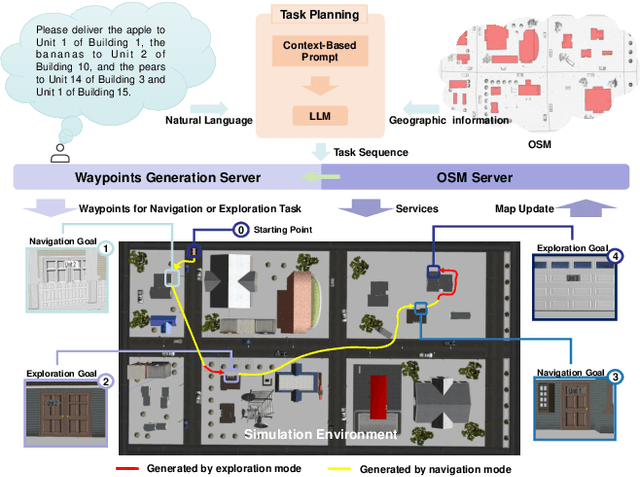
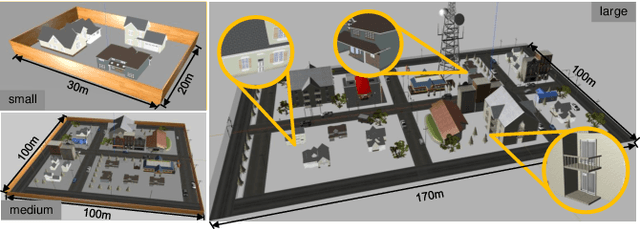
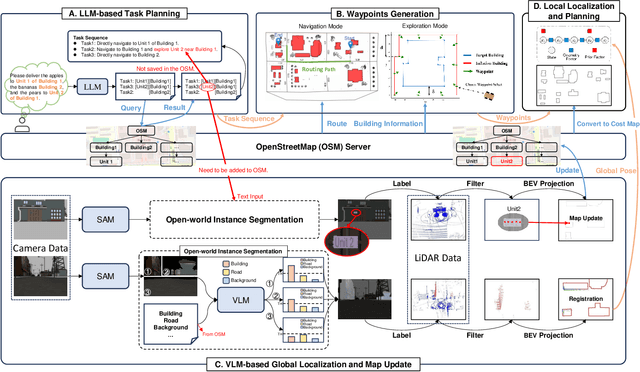
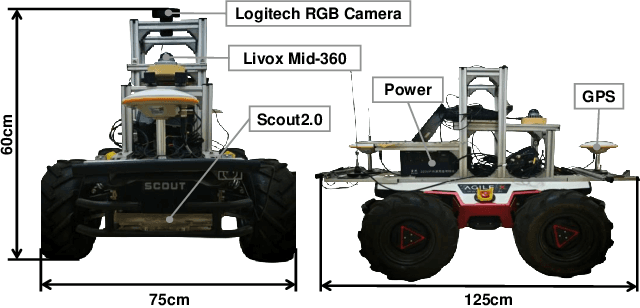
The increasing demand for efficient last-mile delivery in smart logistics underscores the role of autonomous robots in enhancing operational efficiency and reducing costs. Traditional navigation methods, which depend on high-precision maps, are resource-intensive, while learning-based approaches often struggle with generalization in real-world scenarios. To address these challenges, this work proposes the Openstreetmap-enhanced oPen-air sEmantic Navigation (OPEN) system that combines foundation models with classic algorithms for scalable outdoor navigation. The system uses off-the-shelf OpenStreetMap (OSM) for flexible map representation, thereby eliminating the need for extensive pre-mapping efforts. It also employs Large Language Models (LLMs) to comprehend delivery instructions and Vision-Language Models (VLMs) for global localization, map updates, and house number recognition. To compensate the limitations of existing benchmarks that are inadequate for assessing last-mile delivery, this work introduces a new benchmark specifically designed for outdoor navigation in residential areas, reflecting the real-world challenges faced by autonomous delivery systems. Extensive experiments in simulated and real-world environments demonstrate the proposed system's efficacy in enhancing navigation efficiency and reliability. To facilitate further research, our code and benchmark are publicly available.
Learning-based Sketches for Frequency Estimation in Data Streams without Ground Truth
Dec 04, 2024Estimating the frequency of items on the high-volume, fast data stream has been extensively studied in many areas, such as database and network measurement. Traditional sketch algorithms only allow to give very rough estimates with limited memory cost, whereas some learning-augmented algorithms have been proposed recently, their offline framework requires actual frequencies that are challenging to access in general for training, and speed is too slow for real-time processing, despite the still coarse-grained accuracy. To this end, we propose a more practical learning-based estimation framework namely UCL-sketch, by following the line of equation-based sketch to estimate per-key frequencies. In a nutshell, there are two key techniques: online training via equivalent learning without ground truth, and highly scalable architecture with logical estimation buckets. We implemented experiments on both real-world and synthetic datasets. The results demonstrate that our method greatly outperforms existing state-of-the-art sketches regarding per-key accuracy and distribution, while preserving resource efficiency. Our code is attached in the supplementary material, and will be made publicly available at https://github.com/Y-debug-sys/UCL-sketch.
Diffusion Models Meet Network Management: Improving Traffic Matrix Analysis with Diffusion-based Approach
Nov 29, 2024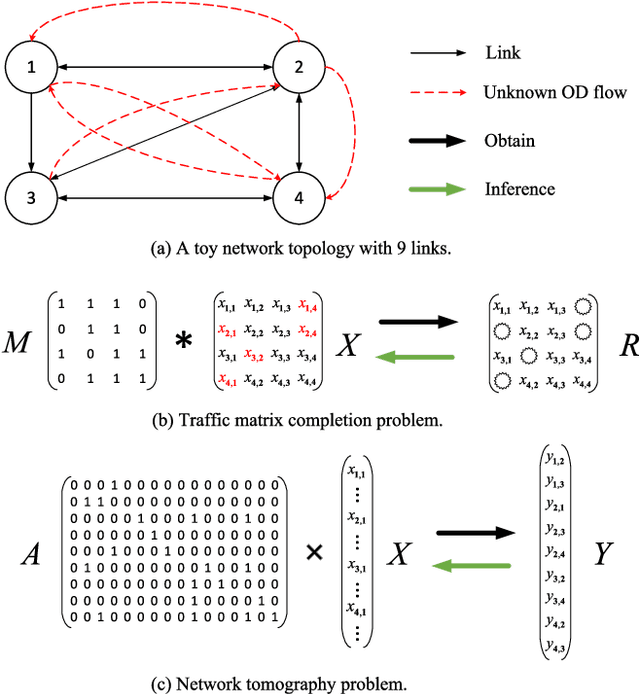
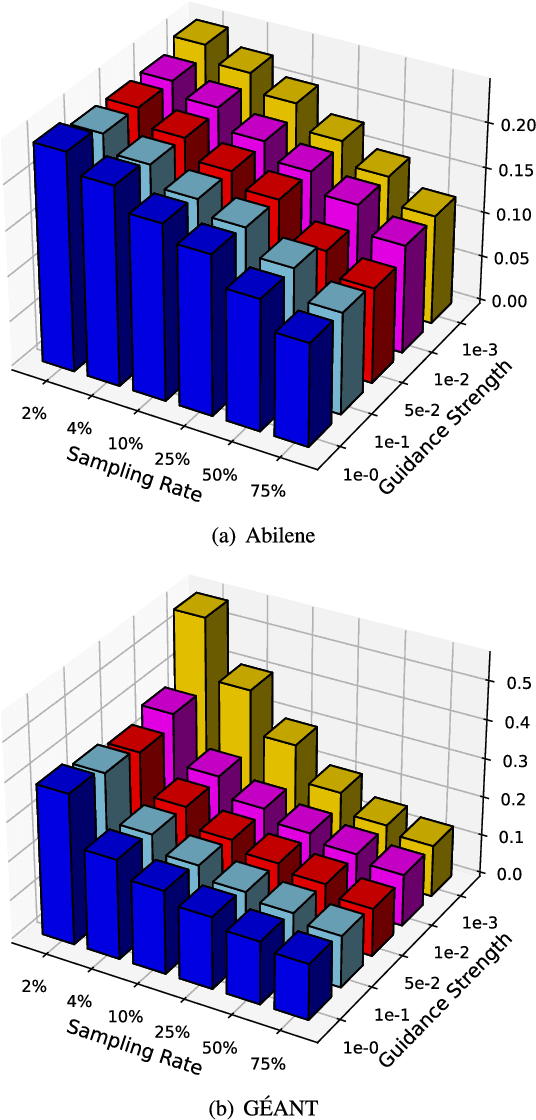
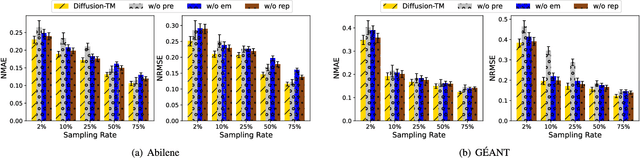
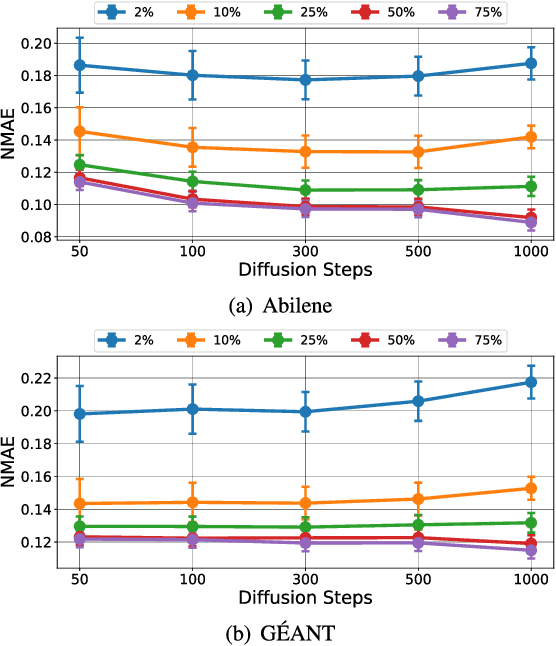
Due to network operation and maintenance relying heavily on network traffic monitoring, traffic matrix analysis has been one of the most crucial issues for network management related tasks. However, it is challenging to reliably obtain the precise measurement in computer networks because of the high measurement cost, and the unavoidable transmission loss. Although some methods proposed in recent years allowed estimating network traffic from partial flow-level or link-level measurements, they often perform poorly for traffic matrix estimation nowadays. Despite strong assumptions like low-rank structure and the prior distribution, existing techniques are usually task-specific and tend to be significantly worse as modern network communication is extremely complicated and dynamic. To address the dilemma, this paper proposed a diffusion-based traffic matrix analysis framework named Diffusion-TM, which leverages problem-agnostic diffusion to notably elevate the estimation performance in both traffic distribution and accuracy. The novel framework not only takes advantage of the powerful generative ability of diffusion models to produce realistic network traffic, but also leverages the denoising process to unbiasedly estimate all end-to-end traffic in a plug-and-play manner under theoretical guarantee. Moreover, taking into account that compiling an intact traffic dataset is usually infeasible, we also propose a two-stage training scheme to make our framework be insensitive to missing values in the dataset. With extensive experiments with real-world datasets, we illustrate the effectiveness of Diffusion-TM on several tasks. Moreover, the results also demonstrate that our method can obtain promising results even with $5\%$ known values left in the datasets.
Traffic Matrix Estimation based on Denoising Diffusion Probabilistic Model
Oct 21, 2024


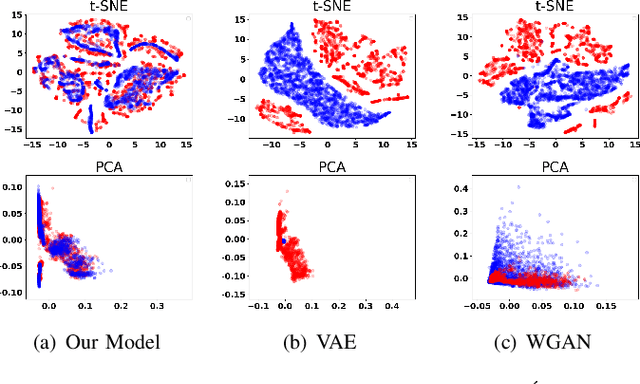
The traffic matrix estimation (TME) problem has been widely researched for decades of years. Recent progresses in deep generative models offer new opportunities to tackle TME problems in a more advanced way. In this paper, we leverage the powerful ability of denoising diffusion probabilistic models (DDPMs) on distribution learning, and for the first time adopt DDPM to address the TME problem. To ensure a good performance of DDPM on learning the distributions of TMs, we design a preprocessing module to reduce the dimensions of TMs while keeping the data variety of each OD flow. To improve the estimation accuracy, we parameterize the noise factors in DDPM and transform the TME problem into a gradient-descent optimization problem. Finally, we compared our method with the state-of-the-art TME methods using two real-world TM datasets, the experimental results strongly demonstrate the superiority of our method on both TM synthesis and TM estimation.
Diffusion-TS: Interpretable Diffusion for General Time Series Generation
Mar 14, 2024Denoising diffusion probabilistic models (DDPMs) are becoming the leading paradigm for generative models. It has recently shown breakthroughs in audio synthesis, time series imputation and forecasting. In this paper, we propose Diffusion-TS, a novel diffusion-based framework that generates multivariate time series samples of high quality by using an encoder-decoder transformer with disentangled temporal representations, in which the decomposition technique guides Diffusion-TS to capture the semantic meaning of time series while transformers mine detailed sequential information from the noisy model input. Different from existing diffusion-based approaches, we train the model to directly reconstruct the sample instead of the noise in each diffusion step, combining a Fourier-based loss term. Diffusion-TS is expected to generate time series satisfying both interpretablity and realness. In addition, it is shown that the proposed Diffusion-TS can be easily extended to conditional generation tasks, such as forecasting and imputation, without any model changes. This also motivates us to further explore the performance of Diffusion-TS under irregular settings. Finally, through qualitative and quantitative experiments, results show that Diffusion-TS achieves the state-of-the-art results on various realistic analyses of time series.